Emerald ash borer has killed millions of ash trees across Ohio. Here's how to spot the signs on your own tree, why a dead ash is more dangerous than most, and what your options are.
If you have an ash tree in Northeast Ohio, there’s a good chance it’s been affected by emerald ash borer, a small metallic-green beetle that has killed millions of ash trees across Ohio and the Midwest. It’s one of the most common reasons we get asked to look at a declining tree around Painesville and Lake County. This is how to recognise it, why it matters, and what your options are.
Is it an ash tree?
Ash leaves are compound: a central stem with several leaflets, arranged in pairs directly opposite each other, and the branches also grow in opposite pairs. Mature bark has a distinctive diamond-shaped pattern of ridges. If you’re not sure, we can tell you on the estimate.
Signs of emerald ash borer
- Thinning from the top. The upper canopy has fewer leaves and dead twigs, and the thinning moves downward over a few years.
- D-shaped exit holes. Small holes about an eighth of an inch across in the bark, shaped like a letter D.
- Woodpecker damage. Patches where the outer bark has been flaked off by woodpeckers going after the larvae.
- Vertical cracks in the bark, and winding, S-shaped tunnels under the bark if a piece comes off.
- Sprouts low on the trunk, a sign of a tree under stress.

Why a dead ash tree is a bigger safety problem
Ash wood that has been killed by the beetle tends to become dry and brittle quickly, and branches can drop or the whole tree can fail with little warning. That makes dead ash trees risky to climb and risky to leave standing, especially near a house, garage, driveway or property line. The same principle applies to any dead tree, which we cover in the signs a tree needs to come down.
What are your options?
- Healthy ash, no signs: keep an eye on it. Treatment to protect a valuable tree is done by licensed pesticide applicators or arborists who offer it; we don’t offer treatment, so ask about that separately.
- Declining ash: once a tree has lost much of its canopy, treatment is usually no longer effective. Plan for removal.
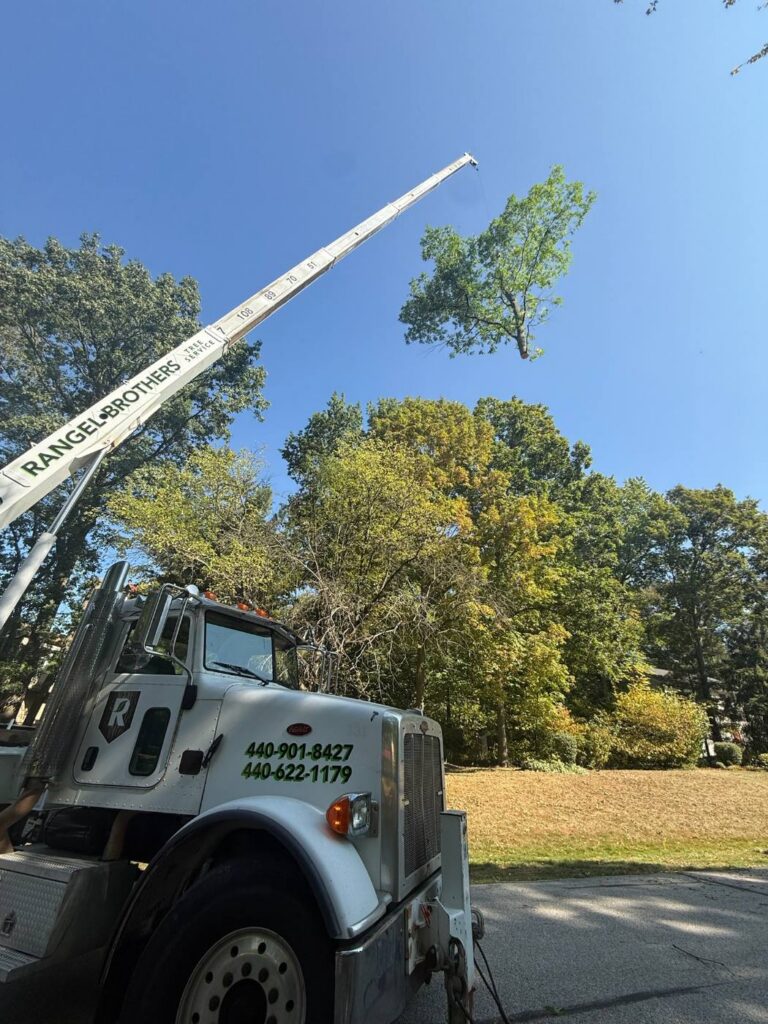
- Dead ash: take it down before it fails. Where it’s over a structure, we lift it out in sections with the crane instead of dropping it.

How we take down a dead ash
Dead wood isn’t something we trust to climbing and ropes alone. We use the bucket truck, the tracked spider lift or the 108-foot crane as the tree requires, so people aren’t relying on brittle wood, and each section comes down in a controlled way. The chipper and skid steer clear the debris the same day (how same-day cleanup works), and the stump can be ground out in the same visit (why that’s usually worth it).
Not sure about your tree?
We’ll look at it and tell you plainly what we see, whether it’s an ash and whether it’s alive, declining or dead, and give you a real number if it needs work. The estimate is free and you don’t need to be home. See what happens during a free estimate and what affects the cost. Our crew works across Lake County and the surrounding counties: see where we work, request a free estimate, or call 440-901-8427. We’re fully insured and bonded.